|
HF Propagation Tools and Solar Data are now on multiple pages for faster loading
- Use the buttons at the top and bottom of the page to navigate, or use the following links:
- For NOAA's SWPC WSA-Enlil Coronal Mass Ejection (CME) Solar Wind Prediction Model click here
- For Solar-Terrestrial Data banners and widgets (both web page and devices) click here
- For Understanding/Using Solar-Terrestrial Data, Solar Images, and HF Tutorials click here
- For current Space Weather and HF Propagation Conditions, and MUF Maps click here
- pdf presentation that contains tutorials and information on understanding radio propagation, and how to use all the data contained in the solar panels. You can download from this link
- pdf presentation that contains detailed instructions on adding a banner to your www.qrz.com BIO page. You can download from this link
Online Maximum & Lowest Observed Frequency (MOF & LOF) HF Propagation Prediction Tool
- For 3,000 kilometer radio signal single hop paths (original tool Courtesy of K1TTT)
- N0NBH Tool enhancements include a different global map, resolution & auto population of your location, and obtaining & auto population of current SFI, A-Index, and K-Index conditions
- Just click "NOW" as all settings (including location) are auto-populated using the current NOAA solar data indices.
- I resolve and populate your coordinates using your IP address. If not correct, just click your QTH location on map then click "NOW".
- Select desired mode/map/overlays. Key shows bands.
- Click "Next Hour" to advance one hour.
 Enter desired future NOAA/SWPC predicted SFI, A-Index, K-Index, Month, Day, and UTC Time (current NOAA/SWPC 27-day Space Weather Outlook Table provided below), then click "Compute" for future predictions. Enter desired future NOAA/SWPC predicted SFI, A-Index, K-Index, Month, Day, and UTC Time (current NOAA/SWPC 27-day Space Weather Outlook Table provided below), then click "Compute" for future predictions.
Java Update
Starting with Java 7 Update 51, java no longer supports running of unsigned java applets, and unfortunately it is cost prohibitive to add a digital signature to the MOFLOF tool.
If you get an "Application Blocked by Security Settings" error loading the page, you can still use the online tool on your browser by changing the Java security
settings in the Java Control Panel to medium (not recommended) or by adding https://www.hamqsl.com/ to the exceptions list and leaving the security level
at "high"(recommended). Complete instructions are provided at this Java Settings page.
Download and execute original K1TTT Maximum & Lowest Observed Frequency (MOF & LOF) HF Propagation Prediction Tool on your Windows Computer
- Special thanks to Greg KA1O for the instructions
- Download a zip file of the windows version of the original tool at K1TTT MOF/LOF Tool)
- Extract the files into a folder
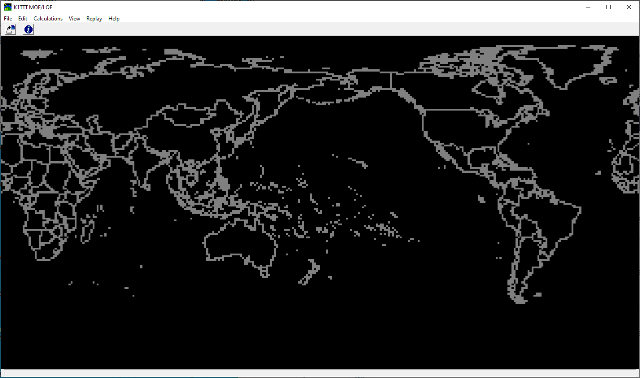
- Launch the MOFWIN application from the extracted files, and the following screen displays
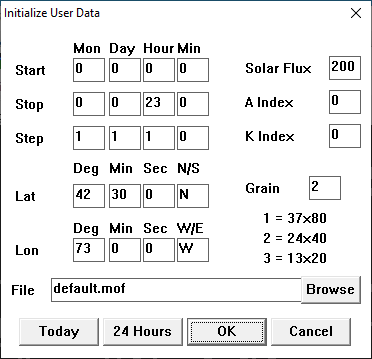
- Click on Calculations then select Start to open a popup screen
- Click on “Today” which populates Start Stop Step Mon Day Hour Min
- Enter SFI, A, K for today and ensure Lat/Long is correct for your QTH
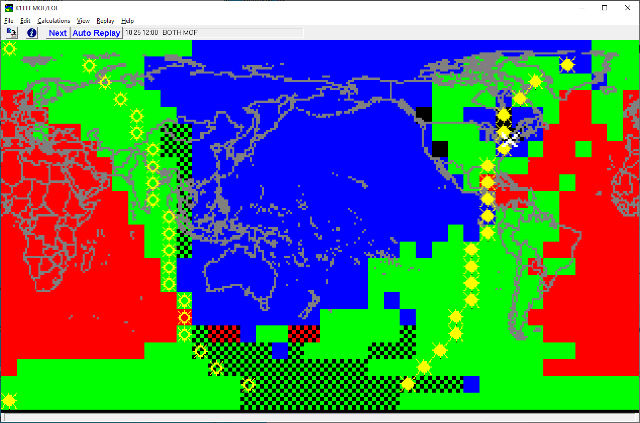
- Click OK, you should see a populated prop map
- Clicking on Next repeatedly will increment the time which is in GMT
- The tutorial below works for this application. You can also download a users manual (for the DOS version but works for this) at Users Manual)
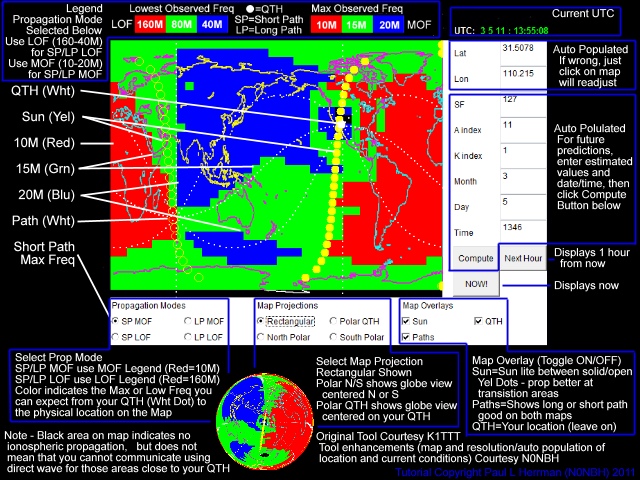
MOF & LOF HF Propagation Prediction Tool Tutorial
- Single image tutorial on how to interpret and use the online prediction tool
Online Solar Terrestrial Data Converters
Online Sunspot Number (SN)/Solar Flux Index (SFI) Converter
- Converts SN to SFI, or SFI to SN. Useful for those programs that require one value, and you only have the other. Also fun to play around with!
- Remember, you are using a measured or observed value to calculate the other using a recognized formula, so the result most likely will not match the other measured value. The solar panel only uses measured/observed values from NOAA.
Online K-Index/K-Measurement Unit (nT)/Signal Noise Level/Geomagnetic Field Converter
- Converts K-Index (from 0-9) to the K-Measurement Unit (in nanoTesla or nT) range, the expected HF signal noise level range in "S" units/dB, and the current Geomagnetic Field state
- You can also enter a specific K-nT value (from 0-999), or specific signal noise level in "S"/dB (0-60), or Geomagnetic Field of Quiet, UNSET, Active, or Storm (any case) to get the other values/ranges.
- Great for figuring out how noisy the bands are
Online Aurora Activity/K-Index/Latitude Converter
- Converts specific Aurora Activity (from 1-10++) to the calculated K-Index (from 0-9), and to the lowest Latitude (North or South Hemisphere) range in Ks that you can expect Auroral activity (either visual or radio frequency)
- You can also enter a specific calculated K-Index (from 0-9), or specific latitude in "°"/Ks (40-90) to get the other values/ranges.
- Great for figuring out when to get outside and look for the northern lights or work VHF Aurora at your location
Online Solar Wind Converter
- Converts specific Solar Wind Values to/from kilometers per second (kps) to/from kilometers per hour (kph) to/from miles per hour (mph). Data cannot be entered for time to earth in hours (display only).
- Remember it rounds, so changes in mph may not impact kps.
- Great for figuring out how long an event will take to get to earth at the current speed.
|
|



 8 Nov 2023